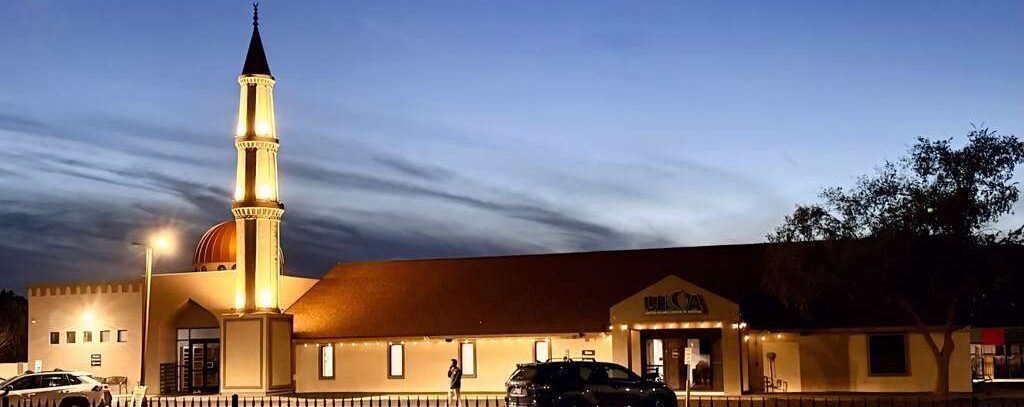

Five Keys to a Purposeful Mosque
Friday Khutbah delivered by Imam Didmar Faja at UICA on October 31, 2025.
All praise is due to Allah. We praise Him, seek His help, and ask His forgiveness. We seek refuge in Allah from the evils of our own souls and from our misdeeds. Whoever Allah guides, none can mislead; and whoever He allows to go astray, none can guide. I bear witness that there is no god worthy of worship except Allah alone, without partner, and I bear witness that Muhammad is His servant and Messenger.
Dear Brothers and sisters,
The success of the Muslim community is not measured by how many projects we announce or how many walls we erect, but by how alive our masjid is.
The masjid is the pulse of our Ummah — if it beats strongly the Ummah thrives. But if it weakens, we all suffer the consequences. Below are five crucial keys to a purposeful mosque.
- A place of Worship (ʿibādah)
The first purpose of the masjid is to give life to prayer (Salah). In the Quran, Allah, the Almighty said:
.فِي بُيُوتٍ أَذِنَ اللَّهُ أَنْ تُرْفَعَ وَيُذْكَرَ فِيهَا اسْمُهُ يُسَبِّحُ لَهُ فِيهَا بِالْغُدُوِّ وَالْآصَالِ
رِجَالٌ لَا تُلْهِيهِمْ تِجَارَةٌ وَلَا بَيْعٌ عَنْ ذِكْرِ اللَّهِ وَإِقَامِ الصَّلَاةِ وَإِيتَاءِ الزَّكَاةِ ۙ يَخَافُونَ يَوْمًا تَتَقَلَّبُ فِيهِ الْقُلُوبُ وَالْأَبْصَار.
“In houses (of worship) which Allah has ordered to be raised and that His Name be mentioned therein; exalting Him within them in the morning and the evenings. (By) men whom neither trade nor sale distracts from the remembrance of Allah and the establishment of prayer and the giving of zakah. They fear a Day when hearts and eyes will be overturned.”
The term worship (ʿibādah) extends far beyond prayer. It includes reading the Qur’an, waiting in the mosque between prayers to perform the next one in congregation, remembering Allah, and sending ṣalawāt upon the Prophet (pbuh) through dhikr. It also encompasses learning beneficial knowledge for the Hereafter, teaching others something of value, and even helping someone in need while in the masjid. All of these are considered acts of worship.
For many of us who were raised in Muslim-majority countries, the sound of the adhān echoing from the minarets was a familiar and comforting part of daily life. A mosque or a small musallā was always nearby—often just around the corner—serving as a constant reminder of the central place of worship and community in our lives. The reason mosques were established in nearly every neighborhood was to make it easy for people to gather for the daily prayers and for other important Islamic activities.
This tradition stems from the strong emphasis the Prophet Muhammad (pbuh) placed on praying in congregation. He said:
عَنِ ابْنِ عُمَرَ رَضِيَ اللّٰه عَنْهُمَا قَالَ قَالَ رَسُولُ اللّٰهِ ﷺ : صَلَاةُ الْجَمَاعَةِ تَفْضُلُ صَلَاةَ الْفَذِّ بِسَبْعٍ وَعِشْرِينَ دَرَجَةً
متفق عليه (البخاري ومسلم)
The prayer in congregation is twenty-seven times superior to the prayer offered by a person alone.”— Agreed upon (Bukhārī and Muslim)
Therefore, it is upon us—especially in lands where the call to prayer is not heard publicly—to make every effort to revive and populate our masjids. We should strive to perform our acts of worship (ʿibādāt) within them, to gather regularly in prayer, so that our mosques remain vibrant centers of faith and community. When describing the person who regularly frequents the mosques, it is reported that Prophet Muhammad (pbuh) said,
إِذَا رَأَيْتُمُ الرَّجُلَ يَعْتَادُ الْمَسَاجِدَ فَاشْهَدُوا لَهُ بِالْإِيمَانِ
“If you see a man frequenting the masājid, bear witness to his faith.”
(al-Tirmidhī)
In many places, mosque leaders provide various services for their congregants to help strengthen their connection to the masjid — such as basketball courts, gyms for men and women, or even swimming pools. These initiatives are commendable and can serve as means to bring people closer to the house of Allah. However, such activities should not become the primary reason for gathering. Even if some view them that way, it remains the responsibility of mosque leadership to continually redirect people’s focus toward the main purpose of the masjid — ʿibādah (worship) and remembrance of Allah.
- A Place of Character and Refinement (al-Tarbiyah wa al-Akhlāq)
Muslims must develop and embody the unique Islamic manners in the mosque and outside. These manners are not meant to be displayed only toward those we know, share backgrounds with, or belong to our own nationalities, but should be extended equally to all believers, especially those who frequent the mosque.
Expressing good manners has a profound impact on our own character development and significantly influences those with whom we engage. People often form impressions of us not just from what we say or do, but from how we say or do it. Someone may speak the truth or give sound advice, but if it is conveyed without proper manners, it may fall on deaf ears. Conversely, good manners can make our words and actions respected, accepted, and even cherished.
A clear example of the Prophet’s teaching on the importance of manners is when a Bedouin urinated in the masjid. The companions immediately moved to stop him, but the Prophet (pbuh) said:
دَعُوهُ، وَهَرِيقُوا عَلَى بَوْلِهِ سَجْلًا مِنْ مَاءٍ
“Leave him, and pour a bucket of water over the urine.”
Then he explained:
إِنَّمَا بُعِثْتُمْ مُيَسِّرِينَ وَلَمْ تُبْعَثُوا مُعَسِّرِينَ
“You were sent to make things easy, not to make them difficult.” (al-Bukhārī)
The Prophet (pbuh) used this moment to teach the companions that mercy must precede discipline. That same man later said, “O Allah, have mercy on me and Muhammad (pbuh) — and on no one else!” The Prophet ﷺ smiled and said,
لَقَدْ تَحَجَّرْتَ وَاسِعًا
“You have narrowed what is vast. (Refering to God’s mercy)”
This story highlights a timeless principle: Tarbiyah (Islamic guidance and education) is not about control or harshness — it is about cultivation and gentle correction. If our mosque’s leadership, teachers, or volunteers become overly harsh, controlling, or judgmental, we risk losing the prophetic method of mercy and ease. True guidance is rooted in gentleness, patience, and exemplary manners, reflecting the Prophet’s way.
- A place of Service (khidmah)
Regular congregants are people of faith — people who work on spiritual and physical purity. About them, Allah says in the Quran,
فِيهِ رِجَالٌ يُحِبُّونَ أَنْ يَتَطَهَّرُوا ۚ وَاللّٰهُ يُحِبُّ الْمُطَّهِّرِينَ
“In it are men who love to purify themselves, and Allah loves those who purify themselves.”
(Sūrat al-Tawbah, 9:108)
Also, Prophet Muhammad (pbuh) when he described the people who frequent the mosques mentioned,
إِذَا رَأَيْتُمُ الرَّجُلَ يَعْتَادُ الْمَسَاجِدَ فَاشْهَدُوا لَهُ بِالْإِيمَانِ
“If you see a man frequenting the mosques, bear witness to his faith.” (Reported by Al-Tirmidhī)
As such, they do not only care for themselves but also for others around them. Since the mosque is the gathering place of the community, regular congregants naturally become aware of the needs and struggles of their fellow worshippers. They learn who is facing financial hardship so they can offer assistance. They find out who is ill so they can visit and comfort them. They come to know who is seeking employment so they can connect them with opportunities or those who can help. They recognize the needs of the masjid itself and respond through volunteering their time, skills, or resources.
A living masjid is not confined to its four walls; it extends its light and compassion beyond them. It becomes a center of service, guidance, and mercy — supporting families, educating children, uplifting the poor, and fostering unity among neighbors. Through such collective care, the masjid fulfills its true role as the heart of the Muslim community — a place where faith is nurtured, relationships are strengthened, and the values of Islam are put into action for the betterment of society at large.
Having the opportunity to help others, especially through a collective effort such as service at the masjid, should never be viewed as merely a favor done for the mosque or for the people. Rather, it should be understood as a means through which Allah expresses His love for the individual, using them to perform deeds that are pleasing to Him. In the sight of Allah, such individuals are among the best of people, for their actions reflect selflessness, faith, and devotion. The Prophet (pbuh) said,
خَيْرُ النَّاسِ أَنْفَعُهُمْ لِلنَّاسِ
“The best of people are those who are most beneficial to others.” (Al-Muʿjam al-Awsaṭ)
- A place of Knowledge (ʿilm)
Beneficial knowledge is that which the Prophet (pbuh) both prayed for and taught his companions in the mosque of Madinah. Among those who exemplified the pursuit of knowledge in the Prophet’s mosque were the Ahl al-Ṣuffah — a group renowned for their zuhd (asceticism), companionship with the Prophet ﷺ, devotion to learning, and transmission of knowledge to others. These were individuals who lived, worshiped, and studied in the mosque alongside the Prophet (pbuh).
From their ranks was Abū Hurayrah (ra), who became the most prolific narrator of ḥadith, transmitting over 5,000 sayings of the Prophet (pbuh). ʿAbdullāh ibn Masʿūd (ra) and Ubayy ibn Kaʿb (ra) were also among the Ahl al-Ṣuffah, becoming renowned scholars of the Qur’an and highly respected authorities among the companions. The Prophet (pbuh) said:
عَنْ عَبْدِ اللَّهِ بْنِ عَمْرٍو قَالَ: قَالَ رَسُولُ اللَّهِ ﷺ: ”خُذُوا الْقُرْآنَ مِنْ أَرْبَعَةٍ: مِنِ ابْنِ أُمِّ عَبْدٍ (ابن مسعود)، وَمُعَاذِ بْنِ جَبَلٍ، وَأُبَيِّ بْنِ كَعْبٍ، وَسَالِمٍ مَوْلَى أَبِي حُذَيْفَةَ.“
The Prophet (pbuh) said: “Learn the Qur’an from four people: Ibn Umm ʿAbd (i.e., Ibn Masʿūd), Muʿādh ibn Jabal, Ubayy ibn Kaʿb, and Sālim the freed slave of Abū Ḥudhayfah.” (Sahīh al-Bukhārī and Muslim)
Throughout the centuries, mosques, through their unique madrasa systems, nurtured individuals who became scholars, imams, jurists, theologians, judges, muftis, psychologists, mathematicians, and more. These scholars were influential not only within their local communities but also contributed knowledge and wisdom that benefited the entire world. Names such as Imam Abū Ḥanīfah, Imam Mālik, Imam al-Shāfiʿī, Imam Ahmad, al-Ghazālī, and Ibn Khaldūn stand as testaments to the enduring influence of Islamic scholarship. Their contributions continue to benefit Muslims and non-Muslims alike.
Our mosques today should aspire to be centers of knowledge, not merely teaching the basics of Islam, but also hosting scholars capable of attracting students to study deeply within the rich, time-honored disciplines of our tradition. That said, these centers of learning should not be places where knowledge is sought merely to win arguments, boast, or show off, but rather to cultivate understanding, spiritual refinement, and service to society. Prophet Muhammad (pbuh) warned,
لا تَعلَّموا العِلمَ لتُباهوا بِهِ العُلماءَ، ولا تُمارُوا بِهِ السُّفَهاءَ، ولا تُخيَّروا بِهِ المجالسَ، فمَن فعلَ ذلك فالنَّارُ النارُ
“Do not seek knowledge to show off before the scholars, nor to impress the foolish, nor to compete for positions in gatherings. Whoever does so, the Fire is his reward.” (Reported by Ibn Majāh, and others)
- The Place of Connection (al-silah)
The Prophet (pbuh) built brotherhood before he built walls. When he entered Madinah, he made brotherhood between the Muhājirīn and Anṣār — pairing hearts before pairing bricks.
When we line ourselves up in the row (ṣaff) in preparation for prayer, it should symbolize more than just physical alignment; it should reflect the connection and unity we maintain with one another outside of prayer. It would be hollow to stand in perfectly straight lines during the prayer while remaining strangers to each other in life, neglecting to support one another in times of need.
The mosque during the time of the Messenger of God (pbuh) was never merely a stop-in place for ritual prayer, nor was it treated as an isolated or transactional space. It was a center of community life, a place where people gathered to learn, advise, support, and care for one another. It was a space of education, consultation, charity, and social cohesion — a hub for spiritual and communal development.
Therefore, our alignment in the saff should remind us to stand together in life as well as in worship, fostering a sense of brotherhood, mutual responsibility, and compassion. True congregational unity is not measured only by the rows in prayer, but by the bonds we cultivate, the help we offer, and the care we show within and beyond the walls of the masjid. Therefore, the Messanger of God (pbuh) said,
”المؤمنُ للمؤمنِ كالبنيانِ يشدُّ بعضُه بعضًا.“
“The believer to another believer is like a building; each part strengthens the other.”
(al-Bukhārī and Muslim))
In conclusion, a purposeful mosque is more than a building; it is a living center of worship, character, service, knowledge, and connection. When we honor these five keys—ʿibādah, tarbiyah, khidmah, ʿilm, and silah—we cultivate a community rooted in faith, compassion, and unity. May Allah (pbuh) guide us to make our mosques vibrant hearts of our Ummah, where His remembrance, mercy, and guidance are reflected in every action and interaction.